Jan 20, 2012


Snap, Crackle, and Pop!

Before the Silver Thaw

After two days of heavy snow a warm front moved in bringing even heavier rain. But we live in a narrow valley on the east side of the Cascade Mountains in Oregon and the frigid air, comfortably settled in, takes days to moderate. As a result the rain is falling through a layer of subfreezing air (26F) and freezes on contact with the surface, any surface. On the one hand it can be quite beautiful (one name for the event is “silver thaw”), on the other, devastating to trees, shrubs, power lines, etc. And driving, for those who must, is simply dangerous. The ice coats each and every branch and twig and leaf or needle and continues to build (like dipping candles) as long as the temperature remains at or below freezing. Several years ago branches were encased in close to half an inch of ice. The weight is tremendous and there is only one inevitability: branches, even whole trees, are snapped off at the weakest point.

Early ice buildup

Around midnight last night I was awakened from what for me masquerades as sleep by a series of snaps, crackles, and pops. My foggy brain thought at first it might be the Chinese New Year, but that is still four days away, I think. I soon realized it was the sound of various tree limbs breaking loose under the unaccustomed weight and crashing to the ground. All night long at varying intervals the night was punctuated with loud bangs. We had just had over a dozen large Douglas firs that towered over the house cut down (now have firewood for a few years) and thanked whatever instinct persuaded us to do it. Even now I can hear the devastation continue. So far our few outbuildings, and the “tea house” and “studio” are unscathed. More rain predicted for this afternoon so things will probably get worse before they get better.

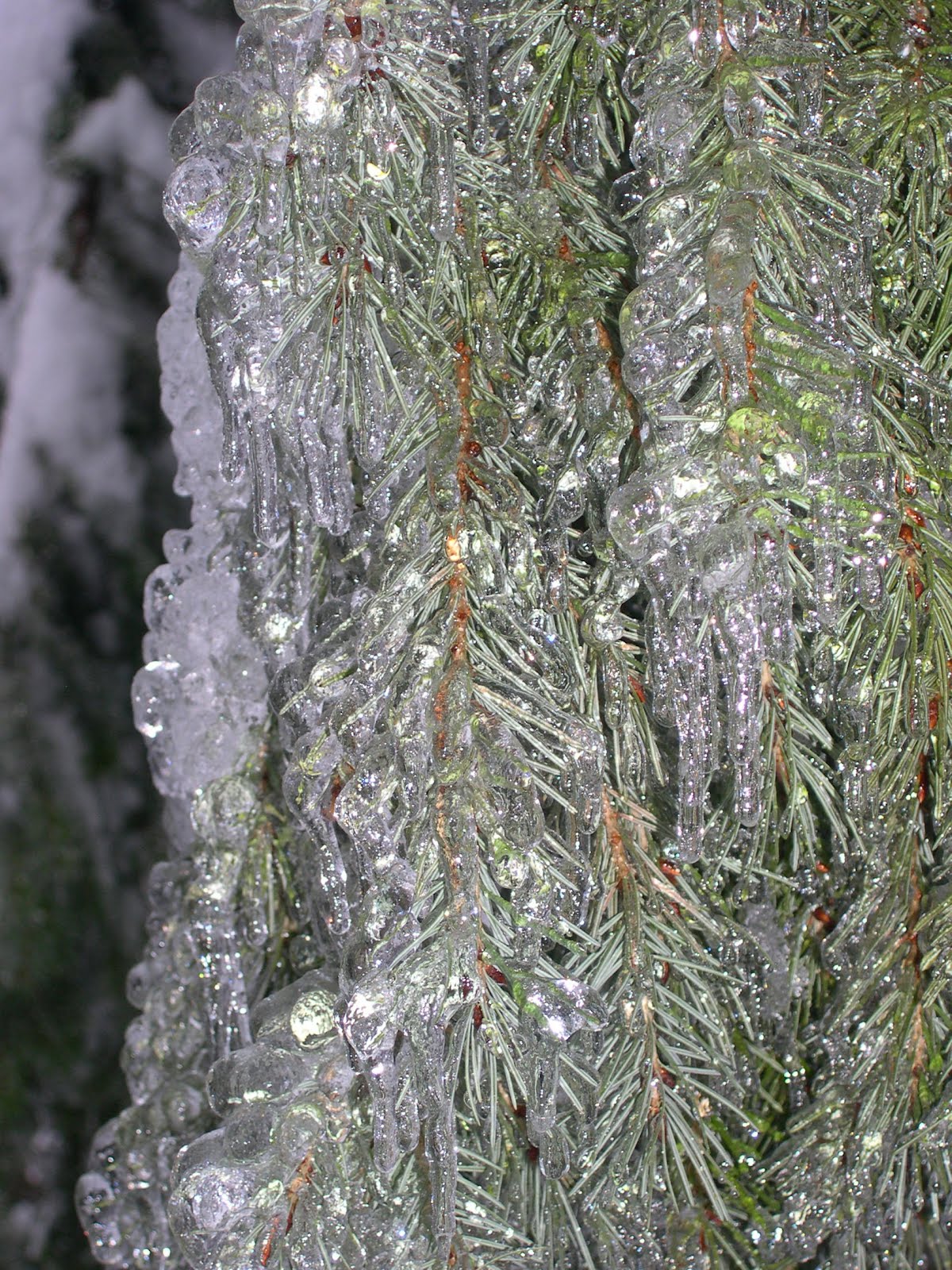
Pruning courtesy of nature

Douglas fir limb encased in ice

Birch tree missing its top

Postscript: As I was about to post this to the blog we lost our internet connection, then electricity. Now, two days later, we are up and running, as they say. As our water is via a well and I've never bothered to buy a generator, we had to do without that luxury too. Damage to the garden is extensive, extensive. And my old greenhouse appears to be a total loss. Now we are being lashed with sleet and the wind is reaching a fevered pitch which will probably bring down more tree limbs , etc. Makes one realize how feeble we are as a species when it comes to dealing with the physical world, despite our vociferous bellowing to the contrary.

Oct 14, 2011


Let the Fireworks Begin


We've yet to experience our first frost which is somewhat unusual and something I hope Al Gore doesn't hear about. But, one of the many vine maples [Acer circinatum] I started from seeds or cuttings many years ago has responded to whatever primeval genetic code orchestrates such things and dyed the top of its canopy Sedona red. Almost makes me want to go into the woods at midnight and perform some ancient Druid dance to hurry the mercury down. We have two other large maples whose leave are only able to produce varying shades of yellow, but we do have five Japanese maple [Acer palmatum], and while small, all under ten feet, their amazingly varied foliage turn half a dozen shades of red, bronze, copper, gold, and a few tints that aren't recognized nor produceable on an artist's pallet. Then there is the incendiary Euonymus alata 'compactus', variety "Chicago Fire". Although in a shady location it too has begun to take on its brilliant crimson fall color.


And so many others who grace our gardens with their temporary farewells, The ancient birch, perhaps the first tree I planted 37 years ago, the leaves of which, while only turning a somewhat uniform yellow are so dense and intense that when light is behind them the tree appears festooned with freshly minted doubloons, but without the portrait of Ferdinand and Isabella. But the treasure chest has not been opened this year, we need the nip of frost to snap the lock.


Most of the Hosta raised from seed earlier in the year (I mentioned them in May) have developed into nice little plants, and, not having decided where to plant them, and, realizing they would not survive the winter in their four inch pots I planted them in three rows in an 'out-of-the-way spot until next spring. When you can't prune a shrub or a rose or a tree without wondering if you might turn the trimmings into additional plants, and you never cease to marvel at the potential hidden in every perennial or annual seed pod, well, you end up with considerably more plants than anyone, other than a commercial nursery, can use. The fifty or so day lilies started from seed last year should begin to flower next year and although I don't expect any surprises, just like buying a lottery ticket, one can always hope that among the new blooms one of them proves to be unique, so different in fact that daylilyomania might sweep the land as did tulipomania Europe in the 1600's and I can at last afford a copy of Hortus Veitchii.